
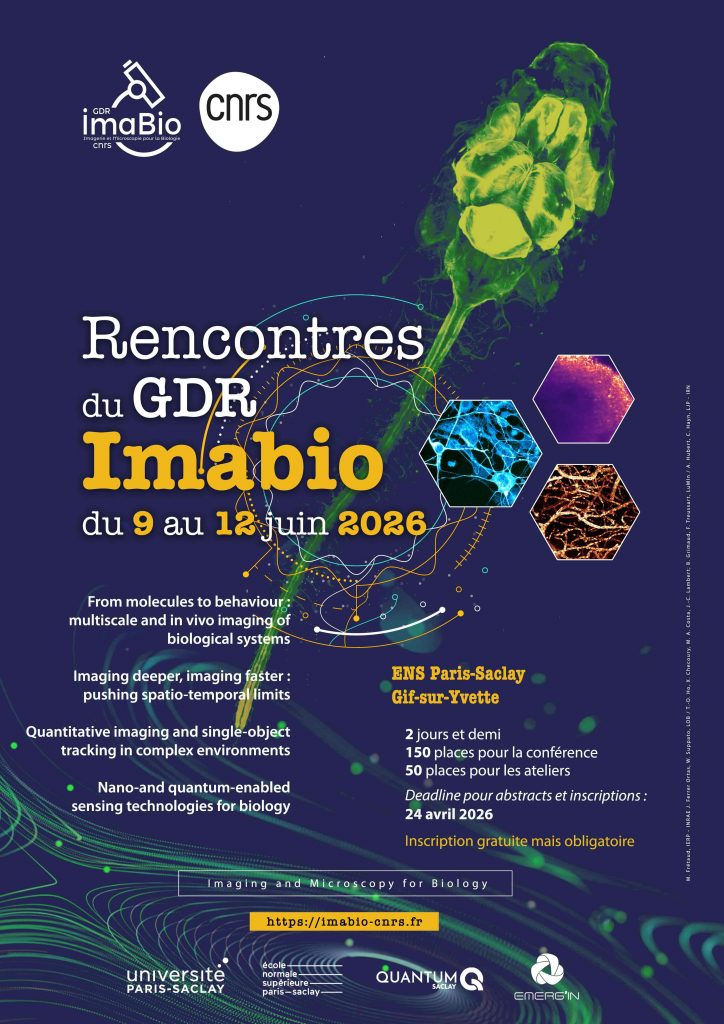
Rencontres du GDR Imabio - 9/12 juin 2026
While MiFoBio keeps you waiting a full year for its Atlantic shores, the GDR IMABIO Days offer you three days of scientific exchange and discovery at ENS Paris-Saclay.
Program highlights:
- Conferences organized around four key themes—though all contributions within the scope of IMABIO are welcome,
- Round tables, tutorials, and lab demo tours—explore cutting-edge experimental setups,
- A special focus on early-career researchers—submit your abstracts for oral presentations or posters.
Registration is free, but seats are limited (approximately 150 for conferences, 50 for workshops).
Abstract submission deadline: 26th April 2026
Registration deadline: 11th May 2026
Practical informations to reach the ENS-Paris-Saclay :
https://lumin.ens-paris-saclay.fr/fr/informations-pratiques-0
Cet évènement a bénéficié d’une aide de l’État au titre de France 2030 (PhOM -Graduate School Physique) portant la référence ANR-11-IDEX-0003
Seminars (150 seats)
From molecules to behaviour: multiscale and in vivo imaging of biological systems
– Kate Grieve (Institut de la Vision, Paris)
– Patrick Lemaire (CRBM, Montpellier)
Imaging deeper, imaging faster: pushing spatio-temporal limits
– Amaury Badon (LP2N, Bordeaux)
– Vincent Villette (IBENS, Paris)
Quantitative imaging and single-object tracking in complex environments
– Guillaume Baffou (Institut Fresnel, Marseille)
– Merlin Lange (Institut de la Vision, Paris)
– Amir Nahas (iCUBE, Strasbourg)
Nano- and quantum-enabled sensing technologies for biology
– Kirstine Berg-Sorensen (DTU, Copenhague)
Microscopy & IA
– Claire Lefort (XLIM, Limoges)
Keynote conference:
Sophie Brasselet (Institut Fresnel, Marseille)
Full program to download here :
Workshops (3-6 seats per workshop)
This workshop will present polarization-resolved SHG (p-SHG) from a theoretical and practical perspective. This modality allows accessing to collagen orientation and local disorder at the micrometer scale. After a short introduction on the theoretical principle, the custom-built microscope will be presented with experimental considerations and data acquisition. Finally, the data processing will be presented to obtain orientation and local disorder information. Gaël Latour, Marie-Claire Schanne-Klein
This workshop will present the CHROMS (Chromatic Multiphon Serial Microscopy) platform designed to map entire organs, such as mouse brains. This platform includes a vibratome integrated into a two-photon microscope in order to automatically perform serial section imaging on large volumes. During this workshop, we will review, from a theoretical and practical perspective, some key experimental aspects of this technique: how to mount the sample, how to perform imaging, cutting, and digital fusion between sections in order to obtain a continuous reconstruction of the sample without artifacts. Pierre Mahou (LOB)
Cellular metabolism is crucial for understanding health and disease and for improving diagnostics and therapies. Label-free optical metabolic imaging using Fluorescence Lifetime Microscopy (FLIM) of endogenous NAD(P)H provides non-destructive, high-resolution information about metabolic activity and cellular heterogeneity. This workshop introduces a standardized framework for acquiring, calibrating, and analyzing FLIM data using phasor analysis, highlighting best practices and emphasizing the importance of calibration, signal-to-noise considerations, and potential biases in data interpretation. Chiara Stringari (LOB)
Dynamic correlation spectroscopy (DCS) allows to characterize motion in scattering media by measuring decorrelation times. The workshop will involve preparing and characterizing scattering solutions with controlled optical properties and viscosity to demonstrate the ability of the DCS method to extract quantitative information under Brownian motion conditions. Frédéric Pain (LCF)
Optical tweezers can apply a controlled force on the adhesion sites of living cells using polystyrene beads. The workshop will involve preparing samples of beads measuring a few microns, trapping them with a focused laser, and measuring the stiffness of the trap by applying a rapid movement to the trap (step response method) via an acousto-optic deflector—a method faster than the traditional approach based on spectral analysis of Brownian motion. This method will be applied to verify the increase in stiffness with laser power or its dependence on bead diameter. Nathalie Westbrook (LCF)
In this workshop we will see some recent methods for object detection and classification from large microscopy volume. In particular we will explore the use of biapy (https://biapy.readthedocs.io/en/latest/), an open source library and application that streamlines the use of common deep-learning workflows for a large variety of bioimage analysis tasks, as well as self-supervised learning via the DINO family of pretrained models. The workshop will consist of notebooks in python that participants could follow on their own machine. Marion Giraud and Anatole Chessel (LOB).
Light microscopy allows proteins of interest to be localized with subcellular resolution of approximately 120 nm using structured illumination microscopy (SIM). The use of reporter proteins or labeling approaches enables the localization of objects of interest with an extremely high degree of specificity. Concurrently, electron microscopy facilitates observation of the entire cellular and subcellular environment with a resolution of approximately ten nanometers. Correlating these two approaches enables the identification of the signal of interest within the context of the other cellular constituents. In this workshop, a workflow will be presented for correlating a high-resolution photonic imaging approach using Lattice SIM (Elyra7 – Zeiss) and a scanning electron microscopy approach (FIB-SEM – Zeiss) on the same biological sample. The following aspects will be examined: sample preparation, the two imaging modalities, the technique for transferring samples from one setup to another, and the post-acquisition image overlap. Valérie Nicolas, Claire Boulogne, Romain Le Bars (I2BC – Imagerie-Gif)
TBA
This workshop presents an experimental framework for the high-bandwidth tracking of nanoparticle position and orientation with nanometric precision. The setup utilizes digital holography implemented via a Digital Micromirror Device (DMD) combined with Second-Harmonic Generation (SHG) signal analysis. This dual approach enables the real-time reconstruction of complex trajectories and rotational dynamics at high sampling rate. François Marquier (ENS Paris-Saclay)
The mesoSPIM project is a unique international initiative in the field of light-sheet microscopy dedicated to large-scale imaging of cleared centimeter-sized samples with sub-cellular resolution. This open-source, cost-effective system matches the performance and complete commercial systems. During the workshop, we will present the functioning and specificities of the mesoSPIM, and present a large amount of pre-processed biological samples such as common zebrafish and mouse organs but also entire common carp and rainbow trout. Maxence Frétaud (INRAe Jouy-en-Josas) – ENS Paris-Saclay
This workshop provides a technical overview of the Abberior Instruments MIRAVA Polyscope, which is part of the MIPSIT platform (UMS-IPSIT). We will demonstrate how the integration of adaptive optics and adaptive illumination protocols optimizes 2D/3D STED imaging. The session will focus on two critical challenges: mitigating depth-dependent aberrations to maintain spatial resolution in thick samples, and repetitive super-resolved imaging of live cell. Séverine Domenichini (UMS-IPSIT, Bâtiment Henri-Moissan).
This workshop presents the contribution of adaptive optics fluorescence microscopy to deep biological imaging. Tissue inhomogeneities distort the light wavefront, thereby degrading contrast, resolution and sensitivity. Adaptive optics, originally developed for astronomy, can correct these optical aberrations by measuring and correcting the wavefront using phase modulators such as deformable mirrors. The workshop will introduce the physical principles and main implementation strategies in microscopy, along with their respective advantages and limitations. A concrete example will be presented in light sheet microscopy for imaging zebrafish embryos. Alexandra Fragola (ISMO)
Recent advances in SPAD array technologies enable fast, widefield fluorescence lifetime imaging (FLIM) with single-photon sensitivity. This workshop will introduce FLIM principles and highlight the performance of next-generation SPAD arrays for time-resolved imaging over large fields of view. The session will cover system implementation, acquisition strategies, and lifetime reconstruction methods along with key practical considerations. Applications in dynamic biological imaging will be presented. Sandrine Lévêque-Fort/Lea Brito (ISMO)
The development of new fluorescent probes capable of switching from an OFF to an ON state without the need for imaging buffers enables the observation of structures in living cells. This workshop will present the properties of these new probes, including JF630b, as well as their conditions of use. Different acquisition modalities will be discussed, along with strategies for reconstructing dynamic structures. Eva Pinto / Sandrine Lévêque-Fort (ISMO)
This workshop will present the ModLoc technique developed in the laboratory, which enables encoding the axial position of single molecules using temporally varying structured illumination. This approach allows imaging of samples with an axial precision below 10 nm and to image in depth with uniform precision. The workshop will provide a detailed presentation of the custom-built experimental setup, and different acquisition schemes will be demonstrated. A. Illand / Sandrine Lévêque-Fort (ISMO)
This educational session provides six dedicated experimental stations for the assembly and alignment of a Full-Field Optical Coherence Tomography (FF-OCT) system. Participants may opt for a full build-up from discrete components or work with pre-aligned sub-assemblies to focus on specific interferometric principles and signal acquisition. Responsable: Gaël Latour (hbar building)
Download the PDF of workshops here : Workshops_rencontres_2026